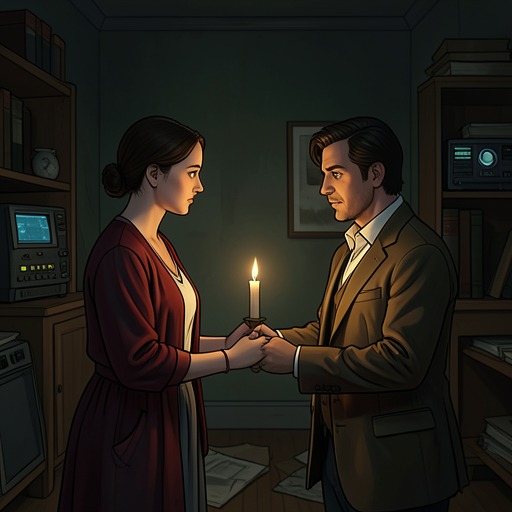
Lula Landry and Evan Duffield’s commitment ceremony
The Cuckoo's CallingLula Landry and Evan Duffield’s commitment ceremony was a spontaneous, non-legal celebration of their reconciliation, held at Dickie Carbury’s house in the Cotswolds roughly a week before Lula’s death. Remembered by their friend Ciara Porter as an intensely romantic gathering, it offers a sharp contrast between the happiness surrounding Lula in her final days and the suddenness of her death; it also becomes a clue in the investigation when the press learns of the private event almost immediately.
Background and Timing
Lula and Evan had been apart for about two months before getting back together at Mo Innes’s party. Their reconciliation came shortly before Lula died, and the ceremony followed within forty-eight hours, according to Evan’s account during questioning. Ciara placed it on the Saturday before Lula’s death and described the couple as having returned from a Vogue assignment in Antigua that last week. In her recollection, Lula was happier then than she had ever seen her: the reunion and the ceremony had left her on cloud nine.
The timing makes the ceremony more than a romantic interlude in the chronology. Ciara struggles to reconcile the Lula she saw, apparently buoyed by renewed love and a celebratory week, with the woman who was dead only hours later. Her disbelief is not evidence about how Lula died, but it records the emotional disjunction that drives questions about the final days: visible happiness and death occupy the same compressed stretch of time.
The Gathering and Its Gestures
The gathering took place over a weekend at the country house of restaurateur Dickie Carbury in the Cotswolds. Evan had bought matching bangles from Fergus Keane: oxidized silver pieces that gave the private occasion a tangible token. After dinner, he made the group go down to the lake in freezing weather and snow, then recited a poem he had written for Lula as he put a bangle on her wrist.
Lula answered by reciting a poem by Walt Whitman. Ciara recalled her laughing, then producing the poem without apparent preparation, a response that made the exchange feel mutual rather than simply staged for her. The matching jewelry and reciprocal poems gave the moment the shape of a vow-like ritual, but the account does not describe formal vows, an officiant, or a legally recognized marriage. Its force came from what the two chose to give and say to one another in front of their friends.
Meaning and Limits of the Commitment
Asked directly whether there had been vows or an officiant, Ciara clarified that the ceremony was not legally binding. She nevertheless described it as a lovely, perfect moment. The distinction matters: this was a public expression of private commitment to the people present, not a legal change in the couple’s status. The bangles and poems served as the ceremony’s signs, while its spontaneity was part of its meaning. Evan later said he had bought the bangles and that they simply did it; he remembered it as beautiful.
The scene’s emotional charge depends on that combination of deliberate gesture and unplanned form. Evan arranged the tokens and recitation, but Ciara and Evan both characterized the event as spontaneous rather than as a formally organized ceremony. Lula’s answering poem completed the exchange. In retrospect, the occasion carries an irony its participants could not have known: it offered a concentrated image of renewed happiness in the last week of Lula’s life, without providing any explanation for the death that followed.
Witnesses, Conflict, and the Press
Ciara was present and remembered the occasion in detail, including the cold, snow, lake, bangles, poems, and the company at Carbury’s house. She also recalled that Freddie Bestigui had been a nuisance, while noting that his wife, Tansy Bestigui, was not there. These details place the ceremony within a social gathering, not a private exchange between the couple alone, and establish that several people could have known what happened.
That circle of witnesses becomes consequential when the investigation turns to the speed with which the press found out about the ceremony. During questioning, the possibility is raised that someone who attended told reporters; Evan confirms that the event was spontaneous. The evidence presented does not identify who disclosed it. The ceremony therefore marks both a moment of shared intimacy and a breach in the boundary around it: what the couple and their friends experienced at Carbury’s house soon became information available to the press.
Narrative Significance
The ceremony complicates any simple picture of Lula’s final week. Ciara’s recollection supplies concrete signs of joy—the reunion, the matching bangles, the poems, and the night in the snow—while the investigation’s questions establish the event’s closeness to Lula’s death and its rapid exposure to reporters. Those facts do not settle what happened to Lula; instead, they sharpen the contrast between what friends witnessed and what remains to be explained.
Its informality is central to that effect. The occasion mattered deeply to the couple and to those present, yet it possessed no legal status and left behind no formal record described in the evidence. In the story, memory carries its details: Ciara’s account gives the ceremony its warmth, Evan’s confirmation supports its spontaneity, and the question of who told the press turns a remembered celebration into part of the inquiry.